Natalie Portman’s Career Comeback: From Star Wars Backlash to Oscar Glory With Black Swan
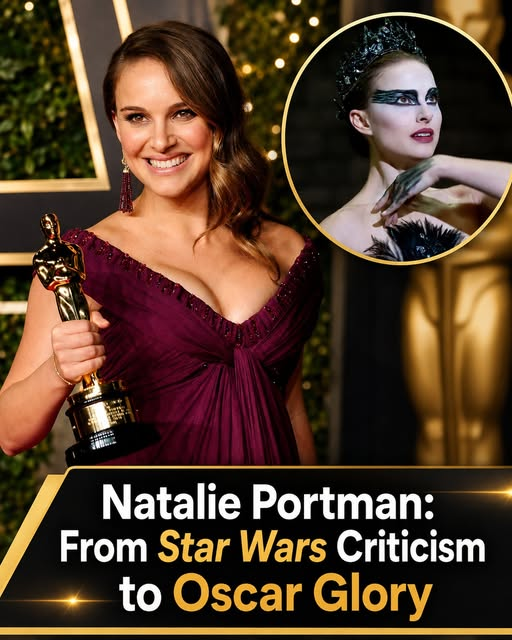
Natalie Portman’s career has been filled with memorable roles, critical praise, and major awards, but one of the most fascinating chapters of her journey came after one of the biggest franchises in movie history nearly changed the way Hollywood saw her. After appearing in the Star Wars prequel trilogy as Padmé Amidala, Portman later revealed that the backlash to those films had a painful impact on her career. According to the actress, the reaction was so harsh that some directors began to see her as a bad actress.
It is a remarkable thing to consider now, especially because Portman would later win the Academy Award for Best Actress for her haunting performance in Black Swan. But before that career-defining moment, she had to fight through doubt, criticism, and an industry that suddenly seemed unsure of her talent.
Portman entered the Star Wars universe with enormous expectations. Cast as Queen Amidala in Star Wars: Episode I – The Phantom Menace, she became part of one of the most anticipated film events of all time. The original Star Wars trilogy had become a cultural landmark, and fans had waited years to see George Lucas return to the galaxy far, far away. The pressure on everyone involved was enormous, especially on the younger actors tasked with bringing the new generation of characters to life.
Padmé Amidala was a major role. She was a queen, a senator, a political leader, and the future mother of Luke Skywalker and Leia Organa. On paper, the character carried huge importance within the Star Wars mythology. But the prequels received a deeply divided response. While the films were commercially successful and later gained a stronger fan following, early criticism was often harsh. The writing, dialogue, pacing, and performances were heavily debated, and many actors involved found themselves caught in the storm.
Natalie Portman has spoken openly about how difficult that period was for her. She explained that after the prequels, many people in Hollywood seemed to believe she could not act. That kind of judgment was especially painful because Portman had already shown impressive ability before Star Wars. Her breakout performance in Léon: The Professional introduced her as a young actress with unusual emotional depth, and she continued to build a strong reputation through films such as Heat and Beautiful Girls.

Yet the scale of Star Wars changed everything. When a franchise that large receives backlash, the criticism can overshadow the individual work of the actors. Portman became associated with dialogue and scenes that many viewers mocked, even though actors can only do so much with the material, direction, and tone they are given. Instead of being seen as a talented young actress caught inside a difficult creative situation, she felt that the industry began to question her talent altogether.
That is what makes her eventual comeback so powerful. Portman did not simply disappear after the criticism. She kept working, kept choosing challenging roles, and slowly rebuilt the perception of what she could do on screen. One of the people who helped support her during that difficult phase was director Mike Nichols, who had worked with her in the stage production of The Seagull and later in the film Closer. Nichols reportedly vouched for her talent when others were hesitant, helping remind Hollywood that Portman was not defined by the criticism surrounding one franchise.
Closer became one of the key turning points in her post-Star Wars career. Released in 2004, the film gave Portman a mature, emotionally complex role and earned her major awards attention. Her performance was raw, intimate, and confident, proving that she could hold her own opposite major actors such as Jude Law, Julia Roberts, and Clive Owen. It was an important reminder that Portman was capable of far more than the stiff royal formality some viewers associated with Padmé.
Still, the ultimate transformation of her reputation came with Black Swan in 2010. Directed by Darren Aronofsky, the psychological thriller gave Portman one of the most demanding roles of her career. She played Nina Sayers, a dedicated ballerina whose pursuit of perfection slowly pushes her into obsession, paranoia, and psychological collapse. The role required emotional vulnerability, physical discipline, technical preparation, and the ability to portray a character losing control from the inside out.
Black Swan was unlike anything Portman had done before. It was elegant and disturbing, beautiful and nightmarish. The film explored ambition, repression, identity, artistic pressure, and the terrifying cost of perfection. At the center of it all was Portman’s performance, which carried the entire movie. Nina was fragile, controlled, desperate, and increasingly unstable, and Portman captured every stage of her transformation with stunning intensity.
What made the performance so acclaimed was not just the physical commitment, though that was impressive. Portman trained extensively to embody the world of ballet and make Nina’s discipline feel believable. But the true power of the role came from the emotional unraveling. She showed a woman trapped by expectation, consumed by self-doubt, and haunted by the fear that she would never be enough. In many ways, that theme echoed Portman’s own career struggle after Star Wars. Nina was fighting to prove herself in a world that demanded perfection, and Portman was proving herself to an industry that had underestimated her.
The result was one of the most celebrated performances of the year. Portman won the Academy Award for Best Actress, along with numerous other major honors. The Oscar did more than reward a single role. It changed the narrative around her career. The actress who had once felt dismissed after the Star Wars prequels was now standing on Hollywood’s biggest stage, recognized as one of the finest performers of her generation.
That career reversal remains one of the most inspiring examples of resilience in modern Hollywood. Portman’s story shows how quickly public perception can shift, especially in an industry that often judges actors based on the success or failure of massive projects. It also shows that a controversial role does not define an entire career. An actor can be doubted, dismissed, or misunderstood, and still come back stronger with the right role, the right director, and the determination to keep going.
Today, the Star Wars prequels are viewed very differently by many fans. A generation that grew up with them has embraced the films with nostalgia and affection. Padmé Amidala is now recognized as an important character in the saga, and Portman’s place in Star Wars history has become far more appreciated. The harsh criticism that once surrounded the prequels has softened over time, and many viewers now see the performances in a more generous and contextual way.
That change makes Portman’s journey even more interesting. What once seemed like a damaging chapter in her career is now part of a larger story about survival, growth, and artistic reinvention. She did not allow the backlash to stop her. Instead, she continued to pursue complex roles and eventually delivered a performance that no one could ignore.
Natalie Portman’s Oscar win for Black Swan was not just a triumph for one film. It was a statement. It proved that the doubts surrounding her after Star Wars had been wrong. It proved that talent can survive criticism. It proved that even after being underestimated by directors, audiences, and parts of the industry, an actor can reclaim the narrative through undeniable work.
From Padmé Amidala to Nina Sayers, Portman’s journey is a reminder that careers are not defined by one reaction, one franchise, or one difficult period. They are defined by endurance, choices, and the ability to evolve. The same actress who once felt Hollywood had turned away from her went on to win its most prestigious acting prize.
That is why Natalie Portman’s comeback remains so powerful. She went from being doubted after one of the biggest film franchises in history to becoming an Academy Award-winning actress at the peak of her craft. In the end, Black Swan did not just give her a great role. It gave her the chance to prove what had been true all along: Natalie Portman was never a bad actress. She was simply waiting for the world to see her clearly again.