Denzel Washington turn a routine UPenn commencement into a fiery 22-minute manifesto on failure that leaves millions of struggling young people openly weeping.
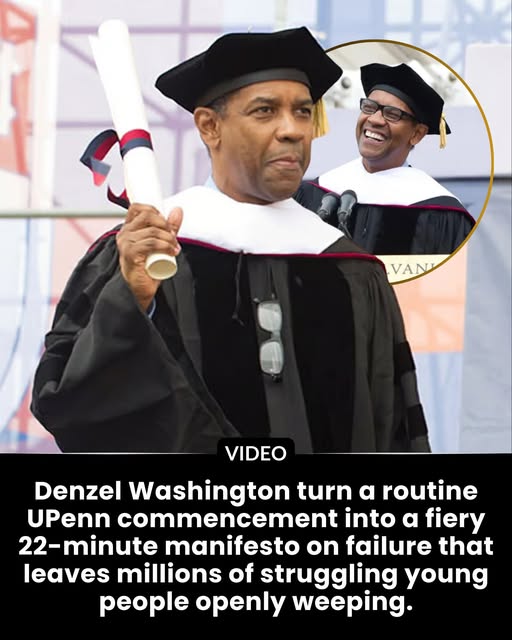
On May 16, 2011, at the University of Pennsylvania’s 255th commencement ceremony, Academy Award-winning actor Denzel Washington delivered an address that transcended the typical graduation platitudes. Instead of celebrating guaranteed success, Washington offered a powerful, deeply personal manifesto on failure, turning a routine UPenn commencement into a fiery 22-minute call to action that left millions of struggling young people openly weeping. He touched the hearts of a generation of confused young people with the concept of “Fall Forward.” The speech, which has since become one of the most viewed motivational speeches on the internet, resonated because Washington didn’t speak from a pedestal of perfection; he spoke from a place of painful, relatable failure.
The Gospel of “Fall Forward”
Washington’s core message challenged the conventional wisdom of having a “plan B” or something to “fall back on.” He argued that if you are going to fall, you should use that momentum to propel you to the next attempt. Washington coined the concept with this central instruction: “If I’m going to fall, I don’t want to fall back on anything, except my faith. I want to fall forward. At least I figure that way I’ll see what I’m about to hit.” He proceeded to share his own moments of professional failure to illustrate the power of taking risks, even when you know you might “suck at something.”
Personal Failure as Proof
Washington’s credibility stemmed from his transparency about his own setbacks, proving that his success was built on an acceptance of loss. He confessed that early in his college career, he had a 1.7 GPA one semester, prompting the university to “politely suggest that it might be better to take some time off.” He recalled this period as his “lowest point,” demonstrating that the path to success is rarely straight. He also shared a humiliating story of auditioning for a Broadway musical, despite having little vocal training. Though he failed to get the part, he didn’t quit. Years later, in 2010, he won the Tony Award for Best Actor in a Play for his performance in August Wilson’s Fences, in the same theater complex where his first musical audition was a bust.
He reinforced his point with statistical data points on famous figures: Reggie Jackson struck out 2,600 times in his career, the most in baseball history, yet he is only remembered for his home runs. Thomas Edison conducted 1,000 failed experiments, but his 1,001st attempt was the light bulb.
The Data of Impact: A Digital Phenomenon
The speech’s candid tone and powerful message ensured its second life online. The video clips of his address quickly amassed millions of views across YouTube and various social media platforms, transforming it into a staple of motivational content that transcended the academic setting. It became particularly popular among young entrepreneurs and artists, who found validation in the idea that failure is a necessary, and even desirable, part of the creative process. The enduring success of the “Fall Forward” manifesto cemented Denzel Washington not just as a screen legend, holding two Academy Awards for his roles as Trip in Glory and Detective Alonzo Harris in Training Day, but as a profound voice of wisdom for a new generation.