Hollywood Pushed Him to Do It—Denzel Washington Refused to Kiss Julia Roberts on Film, a Stunning Stand He Said Was a Promise to Black Women.
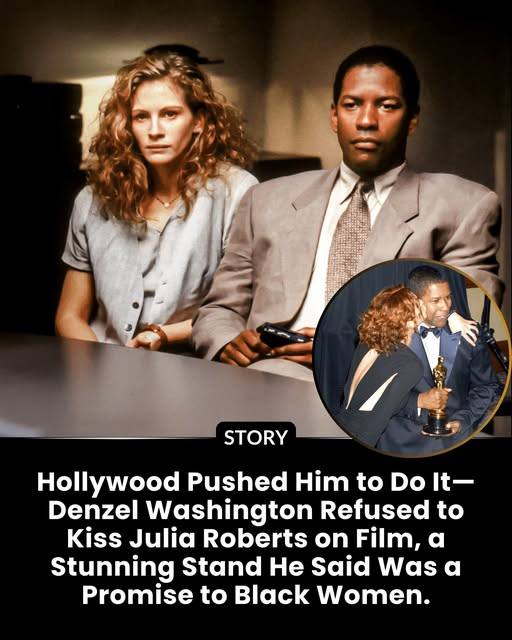
In 1993, two of Hollywood’s biggest box office draws, Denzel Washington and Julia Roberts, were cast as the leads in the film adaptation of John Grisham’s legal thriller, The Pelican Brief. The sheer star power was expected to guarantee massive ticket sales. Studio executives and director Alan J. Pakula naturally wanted to capitalize on their combined on-screen chemistry, pushing for a romantic subplot culminating in a kiss between the two leads. The director asked Denzel to kiss Julia Roberts to get customers, but the world was shocked when he straight-up refused.
However, Washington, who played the journalist Gray Grantham opposite Roberts’ law student Darby Shaw, famously put his foot down, insisting the planned love scene be cut. His reason was not creative or personal, but a matter of deep respect and commitment to his core African-American female fan base.
The Decision to Uphold a Promise
The original script for The Pelican Brief called for a romantic moment between the two main characters. Denzel Washington, who was acutely aware of the demographics of his audience and the cultural landscape of Hollywood, made the bold request to remove the kiss. His motivation stemmed from a promise he felt he needed to keep with his most loyal supporters. Washington knew that many African-American female audiences, who were vital to his box office success, were often frustrated by the Hollywood trend of pairing prominent Black male leads—especially those who represented an ideal of Black masculinity—exclusively with white female leads on screen. This preference had been demonstrated by a loud negative reaction from Black women at a test screening for his 1989 film The Mighty Quinn, where he kissed white actress Mimi Rogers.
By refusing the kiss, Washington was making a public statement of integrity: Denzel Washington’s Stated Reason: He made the decision because he felt that African-American women were his core audience. He wanted to respect their feelings and their preference not to see him in a major love scene with a white actress, stating, “Black women are not often seen as objects of desire on film… They have always been my core audience.” The film’s director, Alan J. Pakula, ultimately honored Washington’s request, and the kiss was removed, leaving the relationship between Grantham and Shaw as purely professional and platonic. Roberts herself later admitted that she “took so much [flak]” for the non-kiss, confirming, “Don’t I have a pulse? Of course I wanted to kiss Denzel. It was his idea to take the damn scenes out.”
Data Points: Box Office Power and Audience Loyalty
The decision was a calculated risk that placed artistic integrity and audience loyalty above studio expectations, but the film’s financial success proved that the stars’ chemistry didn’t require a romantic angle. Film Release: December 17, 1993. Director: Alan J. Pakula. Box Office Success: The Pelican Brief was a major hit, grossing over $195 million worldwide on a budget of $45 million. This demonstrated that the lack of a kiss did not diminish its commercial appeal.
The Continuing Debate
Washington’s choice in The Pelican Brief has remained a significant talking point in discussions about representation and casting in Hollywood. While Washington later had romantic scenes with other white co-stars (like Kelly Reilly in 2012’s Flight), his stand in 1993 remains a critical, early example of a Black star using his power to cater to the cultural preferences and identity politics of his fan base. His refusal to kiss Julia Roberts was a powerful act of agency that prioritized the sentiments of African-American female audiences over the easy lure of a guaranteed box office gimmick.
**mitolyn official**
Mitolyn is a carefully developed, plant-based formula created to help support metabolic efficiency and encourage healthy, lasting weight management.