MALCOLM X (1992): A Revolutionary Life, A Timeless Awakening
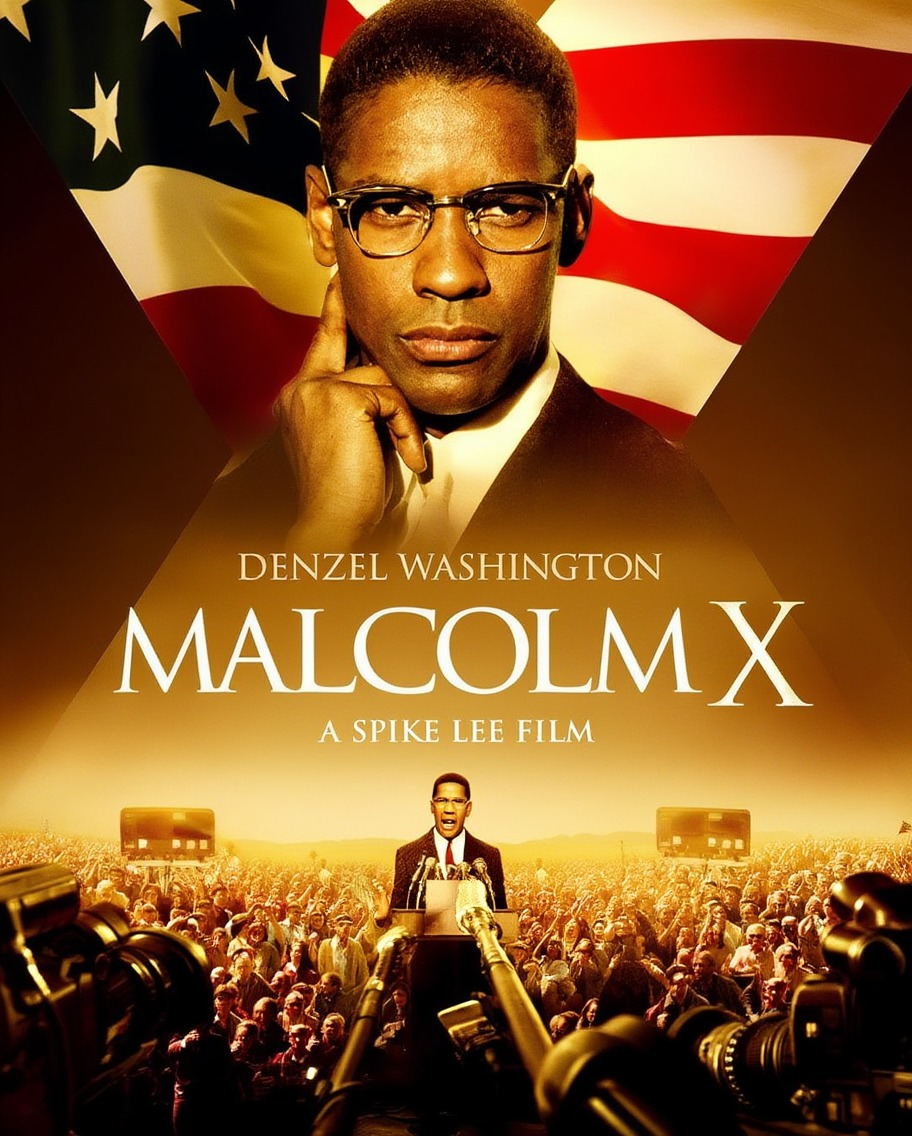
Few films dare to confront history with the intensity, honesty, and moral urgency of Malcolm X. Directed with uncompromising vision by Spike Lee and anchored by a towering performance from Denzel Washington, the film is not merely a biography—it is a cinematic reckoning. It captures the life of Malcolm X as a journey of transformation, self-interrogation, and radical evolution, mirroring the turbulence of America itself.
From its opening moments, Malcolm X announces its ambition. This is not a simplified hero’s tale or a comfortable historical recap. It is a sweeping epic that follows a man who refused to accept the limits placed upon him—by society, by ideology, or even by his own past.
From Malcolm Little to Malcolm X
The film traces Malcolm’s life across several distinct identities, each shaped by trauma, survival, and awakening. Born Malcolm Little, he experiences racism not as an abstract injustice but as a daily, suffocating reality. Spike Lee presents Malcolm’s early years with clarity and restraint, showing how systemic violence and loss plant the seeds of rage long before ideology gives it language.
As a young man, Malcolm descends into crime—not out of moral failure, but out of a society that offers no legitimate path forward. His zoot suits, street hustling, and eventual imprisonment are portrayed not with judgment, but with understanding. Prison becomes the crucible of transformation. It is here that Malcolm educates himself, devours books, sharpens his mind, and encounters the teachings of the Nation of Islam.
This period marks the birth of Malcolm X—a man who rejects the name inherited from slavery and replaces it with a symbol of stolen identity. Denzel Washington’s performance during this transformation is electric. His Malcolm is disciplined, articulate, and unflinching, wielding words like weapons in a nation desperate to silence him.
The Power of Voice and Presence
One of the film’s greatest strengths is its portrayal of Malcolm as a speaker. His speeches are not treated as background noise or historical footnotes—they are cinematic events. The camera lingers, the crowd listens, and the air feels charged. Washington delivers these moments with precision and intensity, capturing both Malcolm’s intellectual rigor and his emotional fire.
Yet the film never portrays Malcolm as static. As his prominence grows, so do the cracks in certainty. Malcolm X dares to show the cost of absolutism. Malcolm’s break from the Nation of Islam is handled with emotional gravity, revealing betrayal, isolation, and spiritual crisis. This is where the film deepens from political biography into human drama.
A Man Who Never Stopped Questioning
What elevates Malcolm X beyond most biopics is its refusal to freeze its subject in a single ideology. Malcolm’s pilgrimage to Mecca becomes the film’s moral turning point. There, he encounters a global Islam that transcends race, forcing him to reconsider beliefs he once held as absolute truths.
Spike Lee handles this transformation with profound respect. Malcolm’s evolution is not portrayed as weakness or contradiction, but as courage—the courage to admit growth, to revise belief, and to seek a broader understanding of justice. The film argues that Malcolm’s greatest strength was not his anger, but his willingness to learn.
This arc makes Malcolm X a rare cinematic portrait of intellectual honesty. It shows a man changing in public, at great personal risk, in a society that punishes nuance.
Direction with Purpose
Spike Lee’s direction is bold, operatic, and deeply political. The film moves confidently between intimate moments and grand historical scope. Montage, music, and visual symbolism are used not to decorate the story, but to confront the audience.
From the haunting opening sequence to the devastating final moments, Lee frames Malcolm’s life as both uniquely personal and universally resonant. The assassination is not sensationalized; it is mourned. The closing images, linking Malcolm’s legacy to future generations, reinforce the film’s central message: ideas do not die with bodies.
Denzel Washington’s Defining Performance
Denzel Washington’s portrayal of Malcolm X stands as one of the greatest performances in cinema history. He captures Malcolm’s charisma, discipline, vulnerability, and evolution with astonishing control. Washington does not imitate—he inhabits.
The performance earned him an Academy Award nomination, though history has widely acknowledged the omission of a win as one of the Oscars’ greatest oversights. Today, his Malcolm X is studied, referenced, and revered as a benchmark for biographical acting.
Why Malcolm X Still Matters
More than thirty years after its release, Malcolm X remains painfully relevant. Its themes—systemic racism, identity, resistance, and the cost of truth—continue to echo in modern discourse. The film does not offer easy answers. Instead, it demands awareness.
This is not a film that asks to be watched casually. It asks to be confronted.
Final Reflection
🔥 Provocative. Inspiring. Timeless.
Malcolm X (1992) is not just a story about a man—it is a challenge to a nation and a mirror for the world. Through masterful direction and a legendary performance, the film reminds us that progress is not born from comfort, and justice is never static.
Malcolm X refused to stop questioning.
This film asks that we don’t either.
Need a reliable Bong88 agent? bong88comibet888 seems like a good option. I’ve heard positive things from friends. Give them a look: bong88comibet888