BIG SKY
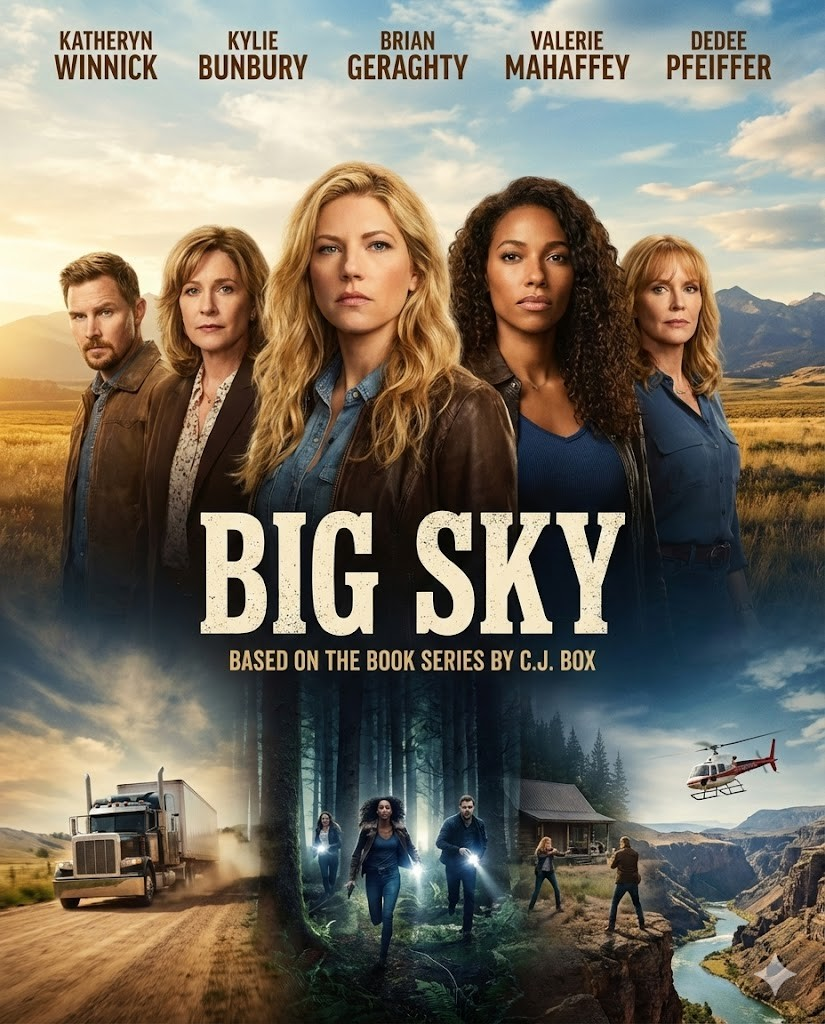
When the Open Road Becomes a Trap
A Crime Thriller Where Silence Is the Loudest Threat
Set beneath the vast, deceptive beauty of Montana, Big Sky is a crime thriller that dismantles the illusion of safety often associated with wide-open spaces. Here, danger does not hide in alleyways or crowded streets—it lives along empty highways, in quiet homes, and behind familiar faces. From its opening moments, the series establishes an unsettling truth: isolation can be more terrifying than confinement.
Big Sky is not just a story about missing women. It is a layered examination of evil, survival, and the psychological cost of living where help is always far away. The show’s tension comes not from spectacle, but from the slow realization that the landscape itself can become an accomplice to horror.
Montana: A Beautiful, Merciless Character
The sweeping landscapes of Montana are more than a backdrop—they are a living presence. Endless highways stretch into the horizon, forests swallow sound, and the sky looms wide and indifferent. This vastness creates an atmosphere where people can disappear without witnesses and crimes can unfold unnoticed.
Big Sky uses this setting with precision. The emptiness amplifies fear, turning every roadside stop into a potential point of no return. The wilderness doesn’t chase its victims; it simply watches. In doing so, the series transforms natural beauty into a source of dread, reinforcing the idea that danger thrives where oversight fades.
A Mystery Rooted in Vanishing Lives
At the heart of the series is a chilling premise: young women are vanishing along a lonely stretch of road. What initially appears to be a conventional missing-persons case quickly spirals into a complex web of abduction, deceit, and long-buried trauma. The investigation pulls private detectives and local law enforcement into a world where nothing is as it seems.
What sets Big Sky apart is its refusal to simplify the mystery. The show constantly reshapes the narrative, forcing viewers to question assumptions and re-evaluate what they think they know. Each revelation deepens the sense of unease, making it clear that this is not just about catching criminals—it’s about understanding how they operate, and why they go unnoticed for so long.
Katheryn Winnick: Strength Forged in Resolve
Leading the series is Katheryn Winnick, who delivers a commanding performance defined by grit, intelligence, and emotional restraint. Her character is sharp and relentless, driven not by ego but by a deep sense of responsibility. Winnick brings credibility to the role, portraying a woman who understands that justice in this world is rarely clean or complete.
Her performance anchors the series, providing moral gravity amid chaos. She is not invincible, nor is she reckless. Instead, she represents perseverance—the kind that survives disappointment, danger, and personal loss. Through her, Big Sky explores what it means to keep going when the odds are stacked against you.
Kylie Bunbury: Empathy Under Fire
Opposite Winnick is Kylie Bunbury, whose portrayal adds emotional intelligence and humanity to the investigation. Where Winnick’s character is hardened by experience, Bunbury’s brings empathy and intuition, creating a partnership forged under constant pressure.
Their dynamic is one of the show’s greatest strengths. It avoids clichés, focusing instead on trust built through shared danger and mutual respect. Bunbury’s performance emphasizes listening over dominance, compassion over aggression—an approach that proves essential in a story centered on victims whose voices are often ignored.
Ryan Phillippe and the Weight of Moral Ambiguity
Ryan Phillippe adds early intensity and moral complexity to the series. His character embodies the ambiguity that defines Big Sky: flawed, driven, and walking a thin line between justice and obsession. Phillippe brings urgency to the screen, reminding viewers that good intentions do not guarantee good outcomes.
His presence sets the tone for the series’ ethical tension. Decisions carry consequences, and heroism is never uncomplicated. In Big Sky, no one emerges unscathed—not even those trying to do the right thing.
Supporting Performances That Deepen the Darkness
The unsettling atmosphere of Big Sky is further enriched by strong supporting turns from Brian Geraghty and Jesse James Keitel. Their characters add layers of unpredictability and psychological tension, reinforcing the idea that danger often wears a familiar face.
These performances resist easy categorization. Characters are not simply good or evil—they are shaped by trauma, secrecy, and survival instincts. This complexity makes the show’s world feel disturbingly real, where morality is fluid and certainty is rare.
Inside the Minds of Predators—and Survivors
One of the boldest choices Big Sky makes is its willingness to shift perspective. The series doesn’t limit itself to investigators; it ventures into the minds of predators and victims alike. By doing so, it transforms from a conventional thriller into a psychological study of power, control, and resilience.
This approach is unsettling by design. Viewers are forced to confront the mechanisms of evil rather than viewing it from a safe distance. At the same time, the show honors survivors—not as passive victims, but as individuals whose strength emerges under unimaginable circumstances. Their resilience becomes a quiet counterpoint to the brutality they endure.
Suspense That Never Loses Its Human Core
Despite its twists and escalating stakes, Big Sky never forgets the human cost at its center. Each disappearance matters. Each decision ripples outward, affecting families, communities, and lives that will never fully return to normal.
The suspense is relentless, but it is always grounded in emotion. Twists arrive quickly, yet they never feel hollow because they are tied to character and consequence. The show understands that fear is most effective when it is personal—and Big Sky keeps its focus firmly on people, not puzzles.
Themes of Isolation, Power, and Hidden Violence
Beneath its thriller surface, Big Sky explores deeper themes: how isolation enables abuse, how power thrives in silence, and how systems fail those who live far from attention. The wide-open sky becomes a metaphor for neglect—a place where crimes can unfold unnoticed simply because no one is watching.
The series challenges the romanticized notion of rural safety, exposing the vulnerabilities that come with distance and isolation. In doing so, it becomes not just entertainment, but commentary—quietly unsettling and deeply relevant.
Final Verdict: Darkness Beneath the Wide-Open Sky
Big Sky is gripping, unpredictable, and emotionally charged—a crime thriller that understands fear does not need shadows to survive. With powerful performances, a haunting setting, and a narrative unafraid to explore uncomfortable truths, the series leaves a lasting impression.
⭐ Rating: 8.5 / 10
A chilling reminder that beneath the vast, beautiful sky, danger can hide in plain sight—and sometimes, the quietest roads lead to the darkest secrets. 🌌🕵️♀️