🎬 SOLO LEVELING: ARISE (2026)
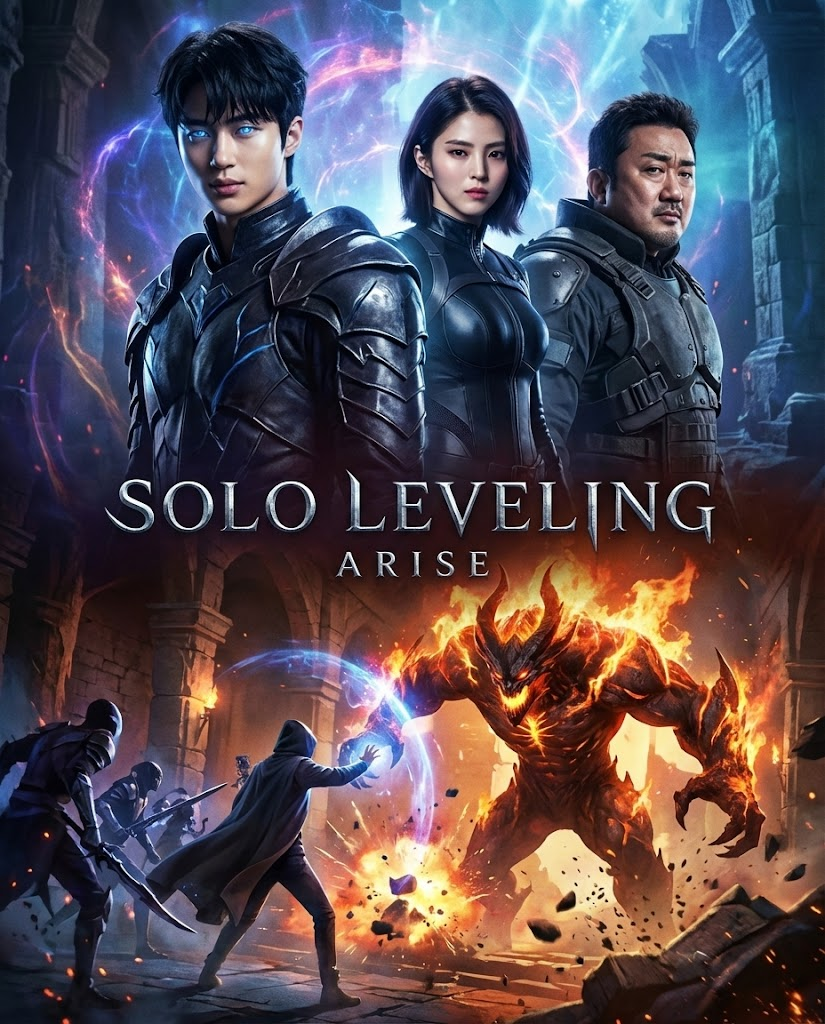
“In a world where no one can grow stronger… he shouldn’t exist.”
Every legend begins with a miracle.
This one begins with a mistake.
In a modern Seoul fractured by supernatural disaster, humanity survives behind a fragile system of ranks and numbers. Gates open without warning. Monsters pour through. And only Hunters — humans awakened with supernatural abilities — can stand between civilization and extinction. But in this world, power is fixed. Once awakened, a Hunter’s strength never changes. You are born strong… or you remain weak forever.
Sung Jin-woo was never meant to matter.
An E-rank Hunter — the lowest of the low — he exists at the bottom of the food chain, dragged into raids only to fill space and absorb casualties. He is mocked, pitied, and dismissed as disposable. Every mission could be his last. Every step into a dungeon is a gamble with death. No one expects him to survive. Least of all himself.
Then comes the double dungeon.
What begins as a routine raid turns into a slaughterhouse. Ancient statues. Impossible rules. A merciless trial designed to erase everyone inside. One by one, Hunters fall — torn apart, crushed, erased. Jin-woo should have died with them. He is weak. Broken. Bleeding out on cold stone.
Instead, something notices him.
When he wakes, Jin-woo isn’t in a hospital bed. He isn’t dead. He is alone — chosen by something that should not exist in this world. A System. A set of invisible rules that allows him to do the impossible: level up. Gain strength. Grow endlessly. In a reality where growth was never allowed, Jin-woo becomes an anomaly.
From that moment on, Solo Leveling: Arise stops being a hero’s journey.
It becomes a descent.
Power does not save Jin-woo — it changes him. Fear begins to fade. Pain becomes irrelevant. Mercy turns optional. Each battle pushes him further from the fragile man he once was, replacing hesitation with calculation, and compassion with efficiency. He doesn’t grow stronger to protect the world. He grows stronger to survive it.
And survival has a cost.
As Jin-woo’s abilities escalate, so does the unease around him. His presence feels wrong — like a system error walking among humans. His movements are precise. His eyes colder. Even among elite Hunters, something about him triggers instinctive dread. Victory follows him, but so does silence.
Only Cha Hae-in truly senses it.
An S-rank Hunter revered for her strength and intuition, she detects a stench clinging to Jin-woo — something unfamiliar, something ancient. Not the smell of blood… but of death itself. As if death has learned how to stand upright. As if it is waiting for a command.
The word comes quietly.
“Arise.”
And the dead obey.
In one of the film’s most haunting moments, fallen enemies do not stay fallen. Shadows stretch, twist, and rise behind Jin-woo — soldiers bound not by loyalty, but by domination. This is not resurrection. It is ownership. And with that command, the truth becomes unavoidable: Jin-woo is no longer merely human.
While the world celebrates victories against dungeon threats, a far greater crisis looms. On Jeju Island, humanity faces annihilation at the hands of an overwhelming enemy force. Conventional power is not enough. Strategy fails. Strength collapses.
The question is no longer whether Sung Jin-woo can stop the monsters.
It’s whether the thing he’s becoming should be allowed to.
Solo Leveling: Arise embraces this moral unease instead of running from it. The film does not romanticize power. It interrogates it. Jin-woo is not crowned a hero by the world — he is feared, watched, and quietly questioned. His growth is breathtaking, but also terrifying. Every victory feels like a step further away from humanity.
Visually, the film is relentless. Dungeons feel oppressive and alive. Combat is visceral, brutal, and stylized with a dark elegance that emphasizes dominance over spectacle. Shadows are not just visual effects — they are characters, extensions of Jin-woo’s will. The transformation into the Shadow Monarch is staged not as triumph, but as inevitability.
This is where Solo Leveling: Arise distinguishes itself from standard adaptations. It understands that the story’s core isn’t power fantasy — it’s transformation. The loss of innocence. The erosion of moral boundaries. The terrifying calm that replaces fear when someone realizes nothing can stop them anymore.
By the time the Shadow Monarch fully emerges, Jin-woo is no longer chasing survival. He is shaping the battlefield. Dictating fate. Standing between humanity and extinction — not as a savior, but as something far more dangerous.
A necessary monster.
The film’s final acts do not offer comfort. They offer clarity. Jin-woo does not reclaim his humanity. He chooses a different role. One defined by control, shadows, and sacrifice. The weakest Hunter is gone — not because he was uplifted, but because he was erased.
What remains is power with purpose… and consequences.
Dark, stylish, and unapologetically intense, SOLO LEVELING: ARISE (2026) delivers the moment fans have waited for — the birth of the Shadow Monarch — in jaw-dropping live action. But more importantly, it dares to ask a question most action epics avoid:
What happens when the strongest being in the world is no longer human enough to care?
⭐ Verdict: Ruthless, electrifying, and unforgettable. This isn’t just an adaptation — it’s a transformation.
⚔️ The weakest Hunter is gone.
🖤 The shadows are standing.
👑 And something new is rising.
Thanks a bunch for sharing this with all people you really recognise what you are talking about!
Bookmarked. Kindly also discuss with my web site =).
We may have a hyperlink exchange contract among us