Kevin Costner’s 17-Minute Farewell to Whitney Houston: A Tribute Too Powerful to Be Timed
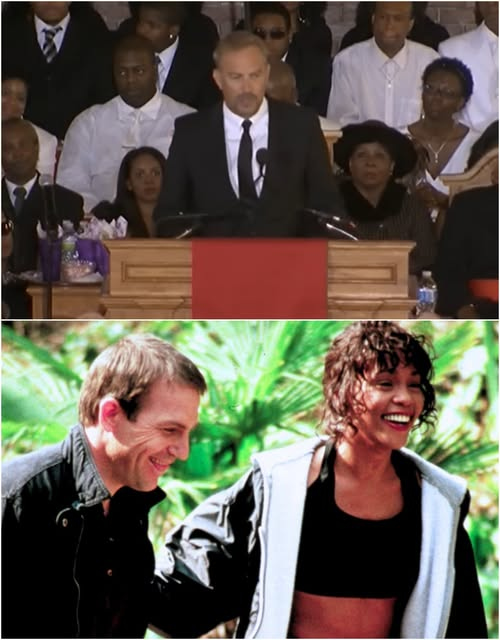
On February 18, 2012, the world gathered in grief to say goodbye to Whitney Houston, one of the greatest voices in music history. Her funeral was not just a private farewell. It became a global moment, watched by millions of people who had loved her music, followed her career, and felt the shock of her passing. The service was filled with emotion, music, memories, and tributes from those who knew her best. But among all the powerful moments that day, one speech still stands out: Kevin Costner’s unforgettable tribute.
Before Costner stepped to the microphone, he was reportedly given a simple instruction: try not to exceed five minutes. The service had been carefully planned, with every tribute assigned a specific time slot. Producers had to think about schedules, broadcasts, commercial timing, and the structure of a televised ceremony. But Kevin Costner was not thinking like a producer. He was not thinking about television. He was thinking about Whitney.
Costner had prepared a speech that ran far longer than the time he had been given. It was around 17 minutes, and he had no intention of cutting it down. For him, Whitney Houston was not a segment in a broadcast. She was not just a superstar whose life had to be summarized quickly between scheduled moments. She was his friend, his co-star, and someone whose talent and vulnerability he had seen up close.
When Kevin Costner finally stood before the church, he did not deliver a short, polished celebrity tribute. He did not offer empty praise or the kind of formal words that sometimes fill public memorials. Instead, he spoke from memory, from affection, and from a place of deep respect. He took the audience back to the making of The Bodyguard, the 1992 film that connected him and Whitney forever.
The Bodyguard became one of the most iconic films of the 1990s, and its soundtrack turned into one of the biggest musical successes of all time. For many fans, Whitney Houston’s performance in the film felt effortless. She was radiant, emotional, graceful, and unforgettable. Her voice carried the movie into history. But Costner’s tribute revealed something many viewers never knew: behind that confidence was a woman filled with doubt.
Costner spoke openly about Whitney’s insecurity before stepping into her first major acting role. She was already a world-famous singer, but acting on that scale was something different. There were people in the industry who questioned whether she could handle the role. There were doubts, concerns, and resistance from powerful voices behind the scenes. Costner made it clear that he believed in her from the beginning. He had fought for her to be cast because he saw something in her that others were too cautious or too blind to recognize.
That detail made his tribute especially moving. He was not simply remembering Whitney as a legend after the world had already accepted her greatness. He was remembering a time when that greatness still needed to be defended. He remembered the young woman who wondered if she belonged, even while possessing one of the most extraordinary voices the world had ever heard.
One of the most emotional moments of the speech came when Costner recalled Whitney asking him a vulnerable question on set. She wanted to know if she was good enough. It was a heartbreaking image: Whitney Houston, a woman with a voice that could silence arenas, asking for reassurance because she feared she might not measure up. In that moment, Costner reminded everyone that even the brightest stars can carry private fears.
His answer to her then became the heart of his farewell years later. He told her she was not just good enough. She was perfect.
Those words landed with extraordinary force. They were not exaggerated praise. They came from someone who had watched her step into uncertainty and transform it into magic. They came from a man who had seen her doubt herself, then watched the world fall in love with her performance. They came from a friend who understood that Whitney’s brilliance was not only in her voice, but in her courage.
In the church, the silence that followed was not ordinary silence. It was the kind of silence that happens when truth reaches everyone at once. The schedule no longer mattered. The time limit no longer mattered. The cameras, producers, and broadcast plans faded into the background. For those 17 minutes, Kevin Costner gave Whitney Houston the one thing no production team could properly measure: time.
That is what made the tribute so unforgettable. It refused to rush grief. It refused to reduce a life to a neat five-minute segment. In a world that often moves too quickly, especially when famous people are being remembered in public, Costner allowed the moment to breathe. He spoke slowly, honestly, and personally. He honored not just the superstar, but the woman behind the image.
Whitney Houston’s life was enormous. She was one of the best-selling and most influential artists of all time. Her voice shaped generations. Her songs became soundtracks to love, heartbreak, faith, celebration, and memory. She had a rare gift that seemed almost impossible to explain. But like many people who live under extreme public pressure, she also carried pain, vulnerability, and private struggles.
Costner’s speech mattered because it did not ignore that complexity. He did not turn Whitney into a perfect statue. He remembered her as human. He spoke about her insecurity, her humor, her beauty, her talent, and her need to be reassured. By doing so, he gave people a fuller picture of who she was. Not only the global icon. Not only the voice. But the woman who wanted to know if she was enough.
After finishing his tribute, Costner reportedly walked to her coffin, kissed it gently, and said his final goodbye. It was a quiet gesture after a powerful speech, and it captured the deep personal emotion of the day. This was not just an actor paying respect to a former co-star. This was a friend saying farewell to someone who had shared a meaningful chapter of his life.
The story of the producer later pointing out that Costner had gone over his allotted time only makes the moment more memorable. His response was simple and powerful: she deserved every second. Whether spoken in those exact words or remembered through the emotion of the day, that idea has become the lasting meaning of the tribute.
Some people cannot be honored properly in five minutes. Some lives are too large, too beautiful, too complicated, and too important to fit into a schedule. Whitney Houston was one of those people. Her impact on music, film, and popular culture was too vast to be timed like a television segment.
Kevin Costner’s tribute remains powerful because it was not about performance. It was about love, memory, loyalty, and respect. It reminded the world that behind every legend is a human being who needed encouragement, friendship, and belief. It reminded fans that Whitney Houston’s greatness was not only in the notes she sang, but in the courage it took to keep standing beneath the weight of expectation.
For 17 minutes, Kevin Costner stopped the clock. He gave Whitney Houston a farewell that felt personal, honest, and deeply deserved. In doing so, he created one of the most touching moments of her memorial service and one of the most memorable celebrity tributes ever delivered.
Some goodbyes should not be rushed. Some people earn the right to be remembered fully. Whitney Houston gave the world a voice that will never fade, and Kevin Costner gave her the kind of farewell that proved true friendship does not look at a clock.
çok yararlı bir paylaşım olmuş teşekkür ederim çok işime yarıcak.
çok başarılı ve kaliteli bir makale olmuş güzellik sırlarım olarak teşekkür ederiz.